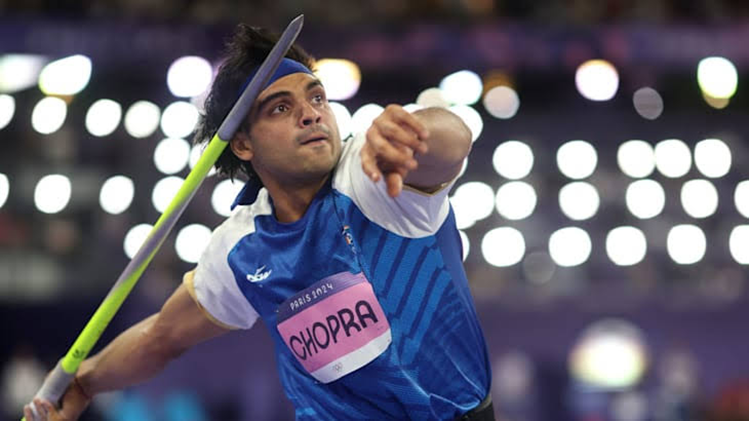
Neeraj Chopra’s success in javelin is often discussed through distances and medals, but those outcomes begin with a sequence lasting only a few seconds. The throw depends on approach speed, rhythm, crossover steps, hip and shoulder positioning, the blocking action of the front leg, arm timing, release angle, and the ability to transfer momentum into the implement. Chopra’s technique stands out because these elements tend to work as one connected movement rather than a series of separate actions.
For spectators, the result can appear simple: the athlete runs, plants, and releases. Yet the biomechanics are more structured than the surface impression, unlike an unrelated digital format such as a lightning roulette live casino game, where the underlying mechanics have nothing to do with athletic execution. In javelin, Chopra must create speed and then redirect it without losing control. His ability to manage that transition is one reason his technique is effective.
The Approach Builds Usable Speed
A javelin thrower needs speed, but maximum sprint speed is not the objective. The athlete must arrive at the delivery phase fast enough to generate momentum while remaining capable of controlling the body.
Chopra’s approach is notable for its rhythm. He accelerates without allowing the run to become disconnected from the throwing motion.
This matters because excessive speed can create problems during the final steps. If the athlete cannot organize the feet, hips, trunk, and throwing arm before the block, some of the momentum is lost rather than transferred into the javelin.
The best approach speed is therefore the fastest speed the athlete can use technically.
Crossover Steps Prepare the Body
The crossover phase separates javelin from a normal running action.
During these steps, the athlete begins positioning the body for delivery while continuing to move toward the throwing line. The javelin is carried back, the shoulders turn, and the lower body continues producing forward momentum.
Chopra maintains separation between his upper and lower body during this phase.
That separation stores rotational potential.
The hips can begin moving toward the throw while the shoulders remain farther back. When the sequence is timed correctly, energy moves through the body rather than being generated almost entirely by the arm.
This is central to his efficiency.
The Impulse Stride Creates the Final Setup
One of the key moments comes immediately before the front leg blocks.
The thrower uses an impulse stride to place the body in a position where forward speed can be converted into throwing velocity.
Chopra’s final steps help him arrive with the javelin behind the body while his center of mass continues moving forward.
This creates tension across the kinetic chain.
The position cannot be held for long. If the upper body rotates too early, the throw loses the sequence required for effective energy transfer.
His timing allows the lower body to initiate the delivery before the arm completes it.
The Front-Leg Block Redirects Momentum
The block is one of the most important differences between an average throw and an elite one.
As the front foot contacts the ground, the front leg provides resistance against the forward motion of the body.
This does not simply stop the athlete.
Instead, it helps redirect momentum through the hips, trunk, shoulder, elbow, hand, and eventually the javelin.
Chopra’s block gives the upper body a base from which to accelerate.
If the front leg collapses too much, the body continues drifting forward and energy is absorbed rather than transferred efficiently.
A stable block helps produce release speed without requiring the throwing arm to generate everything independently.
His Throw Depends on Sequencing
Javelin technique is often described as a kinetic chain.
The important point is not merely that several body segments move. They must move in the correct order.
The lower body initiates the delivery, followed by the hips and trunk. The shoulder then accelerates, with the elbow and hand completing the sequence.
Chopra’s throws often demonstrate this progression.
The arm appears fast because energy has already been generated elsewhere.
This reduces the need to force the javelin with an isolated arm action and helps explain how elite throwers can produce high release speeds from movements that sometimes look controlled rather than violent.
Release Angle Is Only One Variable
It is tempting to judge a javelin throw mainly by its launch angle.
In reality, the ideal trajectory depends on several variables, including release speed, release height, wind, and the orientation of the javelin.
A theoretically attractive angle is useless if achieving it reduces speed.
Chopra’s technique prioritizes the complete release.
The javelin must leave the hand with enough velocity and with an orientation that allows it to travel efficiently.
Small differences at release can produce large differences at landing because the implement travels for several seconds after leaving the hand.
Chopra Does Not Need the Same Model as Every Rival
Elite javelin throwers do not all use identical movement patterns.
Body proportions, strength, mobility, speed, and training history affect how each athlete organizes the throw.
Some competitors may depend more on approach velocity. Others may create more force through their frame or use a delivery that appears more forceful.
Chopra’s technique is notable for balance across the phases.
His success does not depend on copying the athlete with the fastest runway speed or the most visible upper-body effort.
The system is adapted to his physical characteristics.
Consistency Separates Technique From a Perfect Throw
A single long throw can result from a sequence in which almost everything aligns.
Championship success requires something more difficult: repeating effective mechanics under pressure.
Wind conditions change. Qualification rounds require safe distances. Finals create limited opportunities, and fatigue can alter timing.
Chopra’s technique has value because it can be reproduced.
He does not need every throw to be technically perfect. He needs enough of the sequence to remain stable that competitive throws continue to appear across different conditions.
Why Chopra’s Technique Works
Neeraj Chopra’s throwing technique is effective because it connects speed with control. His approach creates momentum without sacrificing rhythm. The crossover steps position the body for delivery, the impulse stride establishes separation, and the front-leg block provides resistance that allows energy to travel through the kinetic chain.
What distinguishes him from other javelin stars is not one isolated technical secret.
Elite throwers solve the same biomechanical problem through movements adapted to their bodies. Chopra’s solution relies on timing, sequencing, balance, and the ability to reproduce those elements when the competition matters.
The javelin may leave his hand in a fraction of a second, but the quality of that release is determined by everything that happens before it.